XPR POS
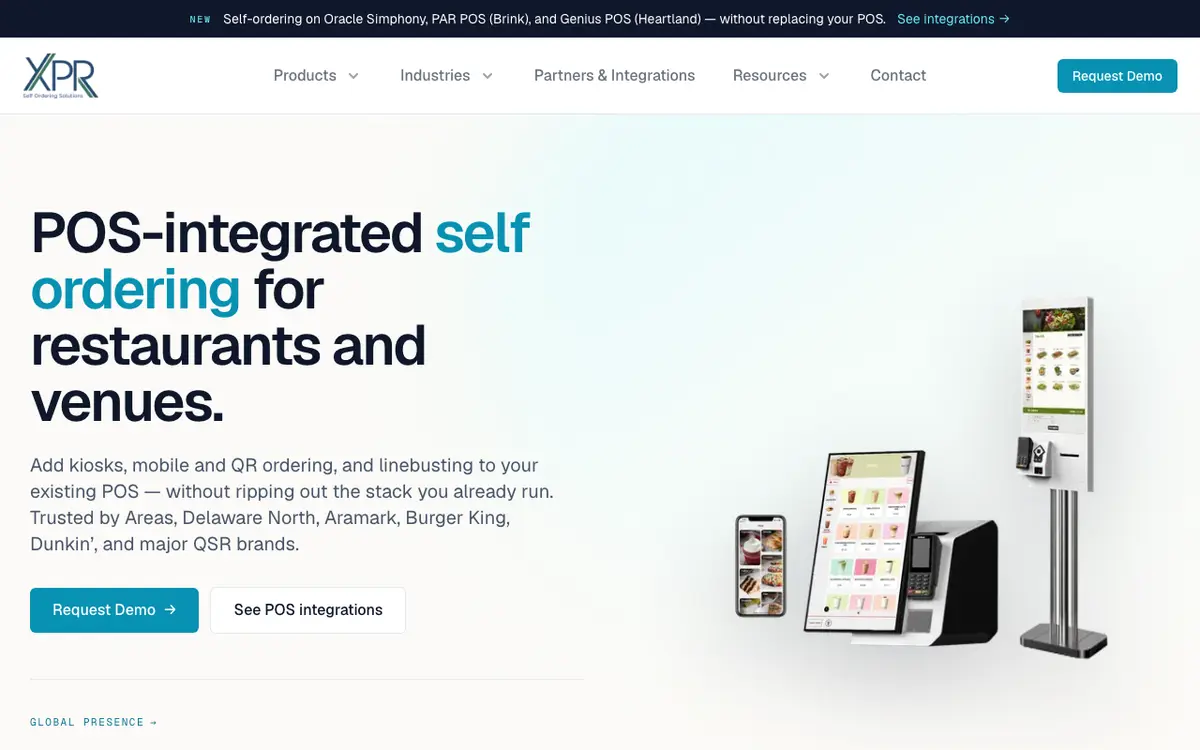
XPR is a self-ordering layer that adds kiosks, mobile and QR ordering, linebusting tablets and order display boards to a restaurant's existing point of sale rather than replacing it. Orders are injected into the POS as if rung at the counter. It is sold to quick-service and fast-casual chains, airports, parks and concessions, independents and POS resellers.
Last reviewed
- Best for
- QSR and fast casual chains, Airports, travel plazas, parks and concessions
- Pricing
- Quote only
- Runs on
- Web, iOS, Android
Who it is for
QSR and fast casual chains
Adds kiosks, mobile and QR ordering to high-volume sites without replacing the POS or payments stack.
Airports, travel plazas, parks and concessions
The vendor cites multi-brand, multilingual deployments at airports and national parks, including Delaware North, Aramark and Areas.
Independent restaurants on Oracle, PAR or Heartland POS
The vendor says there is no enterprise contract and no minimum store count, so one store can start with a single kiosk.
POS resellers
A channel programme lets resellers add kiosk and mobile ordering to their installed base.
What it does
Self-service kiosks
POS-integrated kiosks with live menu sync, upsell prompts, modifier flows and payment by card, mobile wallet, contactless or cash.
Multilingual menus
Menus in 15+ languages, including right-to-left scripts, on kiosks and mobile.
Time-based menus
Breakfast, lunch, dinner, late-night and special-event menus switch automatically.
Order-ready notifications
Optional display board, SMS or email when an order is ready.
Mobile and QR ordering
Branded web app with no download, plus QR ordering at table, seat or room, with order ahead and scheduling.
Promotions and tipping
Promo codes (flat, percentage, BOGO, item-level), tip prompts and split tendering.
Delivery routing
Last-mile delivery through Doordash Drive, Uber Direct or the operator's own drivers.
Linebusting mobile POS
Hardened tablets let staff take orders and payment down a queue or in seats.
Order display board
Shows order status from received to ready, with optional voice call-outs and SMS.
Voice ordering
A voice layer for kiosks aimed at accessibility, queue overflow and multilingual venues.
Business intelligence and management reporting
Separate analytics and reporting products are listed on the site.
Pricing
- Pricing model
- Quote only
No prices are published; the site offers a demo. The mobile ordering page says it charges a flat platform fee rather than a percentage of each order, and 0% commission per order.
How it compares
Compared with the 13 products in Self-Order Kiosk that have a profile on this site. These figures describe the category. They are not a recommendation.
- Names 31 integrations. The median in this category is 6.
- One of 4 products in this category with an iOS app. One of 3 products in this category with an Android app. 10 products in this category state their platforms.
- The category's 10 most-named integration partners are Square, Revel, Apple Pay, Como, Deliverect, Lightspeed, Stripe, Toast, Adyen, Clover. Of these, this product's listing names Square, Revel, Apple Pay, Como, Stripe, Adyen.
Works with
- Accounting
- Oracle NetsuiteMicrosoft Dynamics AX
- Delivery
- Doordash DriveUber Direct
- Other
- Oracle Opera PMSMicros Fidelio PMSGrubtech
- Payments
- Shift4AdyenStripeWorldpayFiserv Card ConnectDatacap SystemsFreedompayApple PayGoogle Pay
- Point of sale
- Oracle MicrosPAR POS (Brink)Genius POS (Heartland)NCR AlohaRevel SystemsPositouchSquirrel SystemsAldeloLS RetailFoodicsEpos NowSquare POS
Some POS integrations are marked as direct and others as available through Grubtech; the partners page also lists many more payment and hardware partners. The vendor says it will build an integration if a POS is not listed.
Where and how it runs
- Customers in
- United States, Greece, Cyprus, Bahrain, Saudi Arabia, United Arab Emirates
- Platforms
- Web, iOS, Android
- Hardware
- Kiosk hardware comes from partners including Elo, Samsung, Pyramid, Olea, Sunmi and Touch Dynamic; linebusting uses hardened tablets. Payment terminals from partners such as PAX and Ingenico are listed.
The home page says XPR is live in 10 countries and names these six; the locations page says 8 countries on 4 continents, including Canada, Europe, the Middle East and Australia.
The company
- Customers named by the vendor
- Delaware North, Aramark, Burger King, Dunkin, KFC, Kennedy Space Center, Daddy’s Chicken Shack, Nomads Entertainment, Canopy Point Coffee
Security and support
- Security and compliance
- PCI Level 1 payments (as stated for kiosks)
- Support
- The vendor says it offers responsive support and tailored onboarding for each menu and location. Independents get the same support as chains.
Listing details
- Vendor
- XPR
- Headquarters
- United States
- Built for
- Restaurants
- Focus
- Food-specific
- Status
- Active
- Website
- xprpos.com
Alternatives to XPR POS
See all 35 in Self-Order KioskBite Kiosk
Bite makes self-ordering kiosk software for quick-service and fast-casual restaurants, convenience stores and food halls.
Names 19 integrations, against 31 for XPR POS.
INFI
INFI is a US platform that adds self-ordering kiosks, online and QR ordering, a branded mobile app, loyalty, kitchen display, restaurant websites and marketing on top of a restaurant's existing POS.
Names 8 integrations, against 31 for XPR POS.
Tabesto
Tabesto sells self-order kiosks for restaurants, along with QR-code order and pay, click and collect, and an order and menu manager.
Names 24 integrations, against 31 for XPR POS.
Grubbrr
Grubbrr (written GRUBBRR on its site) makes self-ordering kiosks and related ordering hardware and software.
Runs on Web, against Web, iOS and Android for XPR POS.
Compare XPR POS
Side-by-side tables built from the same profile data.
What we could not confirm
These points were not confirmed when this page was written.
- Any price, contract term or hardware cost
- Headquarters, founding year, founders, legal entity and team size
- Whether native iOS and Android apps exist (the vendor says mobile can be a branded web app, iOS, Android or QR-only)
- Full list of countries (home page says 10, locations page says 8)
- Security certifications beyond PCI Level 1 for payments
Sources
Facts on this page come from the pages below, checked on 29 September 2026. Prices and features change, so confirm with the vendor before you buy.
- Home pagehttps://www.xprpos.com/
- POS, payment and hardware partnershttps://www.xprpos.com/partners-and-integrations
- Kioskshttps://www.xprpos.com/products/self-service-kiosks
- Mobile orderinghttps://www.xprpos.com/products/mobile-online-ordering
- Linebustinghttps://www.xprpos.com/products/linebusting-mobile-pos
- Display boardhttps://www.xprpos.com/products/order-ready-board
- Voice orderinghttps://www.xprpos.com/products/ai-restaurant-voice-ordering
- Independentshttps://www.xprpos.com/industries/independent-restaurants
- Locations and countrieshttps://www.xprpos.com/locations